31st of July, 2026
DOOMing myself
DOOM. Released by id Software in 1993 as a competitor to Apogee Software's new game Blake Stone: Aliens of Gold, this small-time first-person shooter placed much more emphasis on horror, featuring then-radical real-time lighting effects that could strobe enemies with light or cloak them in darkness, as well as a constant close-up of the battered and fearful face of the main character in the bottom-centre of the screen. The game also had some minor religious elements that may have contributed to the lukewarm public response to the game—some enemies vaguely resemble demons and some geometry in the game superficially resembles Christian and Satanic symbols. If anyone's to blame for these subtle inclusions, it's probably Sandy Petersen, a devout Mormon and one of DOOM's most significant designers credited with roughly two-thirds of the levels in the game (the game's design documents were also at one point allegedly referred to as the “DOOM Bible”).
Whether or not these are the facts, one thing can be said for sure: DOOM was doomed from the start. Senior team members, Petersen aside, quickly divested from the project. Within just a few years, id released an entirely new flagship product named Quake, a much more cohesive and energetic game with a soothing ambient soundtrack…
Okay the bit's done. DOOM is probably one of the most influential videogames of all time. One huge part of that legacy is the Doom engine, open-sourced a few years after the game came out and later ported to every operating system and device under the sun. It's spawned remakes, demakes, total conversions, entirely new games in new genres, and an immeasureable number of community maps and mods, and though I've played a few of these things, I'd never played the original DOOM until last month.
What have I played, then? In order: Sonic Robo Blast 2 Kart (Doom engine kart racer), Mega Man 8-Bit Deathmatch (Doom engine arena FPS), Sonic Robo Blast 2 (Doom engine third-person platformer), Dr. Robotnik's Ring Racers (Doom engine kart racer… 2), DOOM: The Gallery Experience, and the unfortunately-named PICO-8 demake POOM. The closest I came to actual DOOM was MyHouse.wad, which, as anyone who's played it can tell you, is about as far from regular DOOM as you can get while still being the same kinda game.
Much more recently I've been playing a bunch of old-school first-person shooters, tracing a path back to DOOM, the most influential early FPS, and then forwards again. This focus is giving me a clearer understanding of the history of this corner of videogames and how all these games relate to one another—how things people claim one dev team invented actually convergently evolved or were pioneered years earlier—and how muddling all FPS games older than Halo or Half-Life 2 into a single lump under the name “boomer shooter” effaces the history of the genre.
(I guess calling them “old-school shooters” isn't much better, but I think it's a better way of referring to the technical and artistic foundations and differences. “Boomer shooter” to me just feels like either “DOOM clone”, but generalised over an entire decade of games, or “shooters people over 30 say are good”, which barely means anything about anything.)
Before I properly start this review, here's my short review of the game right after playing it:
Full of surprises from the start. Even in the menu it was kinda fascinating to see that such an archetypal capital-G Gamer game has a very easy mode. Other highlights: the ways you can feel the friction of the devs grinding their minds against the technology of the time (e.g. the whole 2.5D planar levels thing); secrets within secrets; how the use of simple lighting effects and darkness adds so much tension and switches up the pace of the game; and how good they got movement feeling already in 1993. It was also interesting to see proto-Quake aspects in some of the later levels: more monumental designs, varied level layouts, and recontextualising places you've already been.
At that time I'd only played through the first three episodes and only on “Hurt Me Plenty” (the middle difficulty), but since then I've played all four on “Ultra-Violence” (the hardest normal difficulty setting).
How to DOOM #
This post is mostly written assuming you've played at least a bit of DOOM. If you've never played it, I strongly recommend giving it a go on at least “Hey, Not Too Rough” difficulty (easy, but not too easy).
There's a million and one different ways to set up DOOM on a modern computer; I use the source port UZDoom. Source ports are basically programs that let you run an original program on something it wasn't built for, like running a game built for old computers on new computers. Some are very faithful to the original, but UZDoom adds new settings and features I don't want to do without, like full mouselook (in the original game you can only look left and right, not up and down, due to how the graphics work). I know that's not the original experience, but I enjoyed it more. UZDoom also adds the ability to jump, which I don't use, because the levels really aren't designed for it.
A source port by itself doesn't let you play the game, though—in order to work, it needs the original game's files. For that, I use the “Ultimate Doom” file from this set, which includes the original three episodes of DOOM released in 1993 as well as the fourth episode released in 1995. Not to be confused with “Final Doom”, a completely different DOOM thing from a year later.
Why to DOOM #
To sum it up in a word, playing DOOM in 2026 was electrifying, like watching A Colour Box and Free Radicals (and finding out the former was made in the 30s and not the 60s like I assumed). It's easy for me to see why this approach to FPS made an indie comeback in the 2010s as people wanted to recreate and build on the experiences they had playing the originals in the 1990s, and moreover why people have been making and playing custom DOOM maps continuously for over three decades.
One of the most striking things is how the game is designed to be, for lack of better words, on your side (as entertainment) compared to more modern shooters from this millennium. Each episode is self-contained, 8 levels long (+1 secret level) and takes maybe 1–2 hours to beat at most. You can jump straight into the later episodes right from the start, if you like. (Wolfenstein 3D and other earlier shooters also do this, but they're nowhere near as fun for me to play.) DOOM is a lot less fragile—precious about how you play—than many similar games. The in-game console is even better, though it was only added after the release of the source code in 1997, so it's not technically part of the original game. You can switch to any level, use cheats, config and debug the game… Honestly, games without at least this level of access just look incomplete.
But beyond all that, this is just a genuinely good game in itself, and fast, too. Maybe not the fourth episode, which is unremittingly brutal at the start, but I think anyone with experience playing FPS can beat the first three episodes of DOOM (with mouselook and a crosshair) on “Hurt Me Plenty” difficulty in probably one evening. As long as you use autosave and the in-game map, this game is a banger that plays well and moves fast.
Guns and ammo #
fists … chainsaw … pistol … shotgun … chaingun … rocket launcher … plasma gun … BFG 9000
There's only six guns, each with one fire mode, plus a basic close-combat attack (fists) and a chainsaw. You start with fists and pistol and have to pick everything else up, but you carry your equipment between levels. The pistol, shotgun, and chaingun are hitscan weapons (immediately hit whatever's under your crosshair, with some inaccuracy) and the rocket launcher, plasma gun, and BFG are projectile weapons (create an in-game object like a rocket or plasma ball that moves until it hits something). The chainsaw, chaingun, and plasma gun all do damage fast enough they can stunlock most enemies in the game if you keep your crosshair on one target.
What else can I say? This arsenal's archetypal and about as simple as they come. Your pistol's weak. Your shotgun's a workhorse that's strong enough to kill weaker enemies in one shot, but takes a sec to pump between shots so you've gotta keep moving or use cover. If you can find them, the chaingun, rocket launcher, and plasma gun will be your power weapons for dealing with larger threats or big hordes. Your fists are a weapon of last resort (unless you get the Berserk powerup) and the chainsaw's only really useful against single non-boss enemies.
The only unusual weapons are the chainsaw and the BFG. The former is a close-combat weapon that basically stunlocks both you and your target, so it's very safe one-on-one, but otherwise a risk. The latter fires a big green energy ball that does massive damage, then fires out invisible hitscan beams from the point it hits. These beams can kill other nearby enemies. A few dozen other nearby enemies. That is to say, the BFG is astoundingly powerful. I'd only ever seen its weedier counterpart from Quake II and I can finally see why the real thing has some kinda cultural staying power.
Beyond that, I feel like it inherits a lot from id's earlier FPS, Wolfenstein 3D. In Wolf3D you get three guns that all share ammo (pistol, submachine gun, chaingun), and each new gun is flatly better than the last. In DOOM there's a few weapons that share ammo (pistol + chaingun, plasma gun + BFG) and the chaingun is flatly better than the pistol. It's a bit more varied than its predecessor, but has the same simplicity and redundancy. Point and click to make things die, get new guns that work faster.
If it sounds like I'm underselling it… there actually is some considered feature design, but mostly in that there are mechanics to stop you from accidentally rocketing yourself in the face. Firstly, when you run out of ammo you automatically switch to another weapon, but these switches follow a priority order: plasma gun > chaingun > shotgun > pistol > chainsaw > rocket launcher > BFG > fists. Mostly that looks like the weapon order—except the rocket launcher and BFG are way, way lower. This means you're very, very unlikely to switch just because you ran out of ammo for another weapon. Secondly, the rocket launcher and BFG have a “safety lock”. If you switch to them while holding the fire button, they won't fire until you release it and press it again. Taken together, it's almost impossible to blow yourself up by automatically switching to the rocket launcher in the heat of battle (or to waste cells firing the BFG when you didn't mean to). Recently I've been playing Blood and it doesn't do all this with its rocket launcher equivalent, and damn is it noticeable in the rare times it matters.
(Though, personally, I would've put the rocket launcher and BFG lower than fists so it's flat-out impossible to switch to them automatically… I dunno what their reasons were for not doing that.)
Gods and monsters #
Zombieman … Shotgunner … Imp … Pinky … Fuzzy … Lost Soul … Cacodemon … Hell Baron … Cyberdemon … Spider Mastermind
The Zombieman and Shotgunner are colour-coded hitscanners with little health, but with their guns they impose a cost on being in the open. The Pinky is a tough and fast melee attacker who imposes a cost on being in cover or tight spaces where they can corner you; the Fuzzy is a semi-invisible Pinky. Imps, Cacodemons, and Hell Barons are all projectile-shooters, each tougher than the last, who make the level more complicated to move through by filling it with fireballs. Finally, Lost Souls are weirdly durable and deal damage by charging straight at you, making them easy to dodge but annoying to kill. That's it, besides the big bosses.
It's a very straightforward bestiary of very simple enemies who act in very limited ways—move towards you, shoot/claw you, rinse and repeat. Cacos and Lost Souls move slightly differently and Pinkies/Fuzzies sometimes come at you from odd angles because they've gotta run around other stuff to get in melee range, but that's about as complex as it gets. There's a strength in that simplicity, though. It's probably easier to craft encounters by combining different enemies who “work” in different ways. DOOM's encounters rarely seem designed with that in mind, though, and the most complex decisions you have to make tend to be “should I kill the weaker fodder or one stronger enemy first” or “should I kill the Pinky that's forcing me to move or the fodder filling the space I'm moving in”. Three decades later and the DOOM community's made a fine art out of encounter design, but they're also heavily reliant on the more-complex enemies added in DOOM II.
The one neat touch about enemy AI in the Doom engine is that they respond to sound. Or at least, the sound of your attacks. The designers never really use this in any interesting way gameplay-wise—there's never any stealth—but it's a neat effect to blast something and hear a chorus of snarls on the other side of doors and walls that lets you know you're in danger.
All that said, I don't think the way the original level designers use enemies in DOOM is bad. One of the more enduring memories I have of playing this game the first time is creeping through the mainframe maze in E1M2: Nuclear Plant—winding branching paths where the lights pulse and flicker—peeking around corners and shotgunning single enemies in the dark. Not everything has to be a combat puzzle!
As for the bosses… they're not that interesting to me and, with very few exceptions, I'm not sure I've ever played a custom map where they were used interestingly either. The Cyberdemon volleys rockets that kill you in one shot (two if you've got very high health and armour). The Spider Mastermind is a hitscanner who shreds your health. They both dish and take huge damage and they both have the same simple AI as regular enemies, but one mistake means death, or near enough.
Pistol start #
You start each episode with almost no gear—a pistol, your fists, full health, no armour. Battling through the levels, sniffing out secrets, you steadily build an arsenal with more and more firepower—you find massive health and armour bonuses that carry from one level to the next—the levels tend to get harder, but you get stronger faster. It's the most raw kind of FPS power fantasy.
“Pistol start” does away with all that. it's a challenge where you reset at the start of every level. Pistol, fists, full health, no armour. Tricky, yes, but not impossible. After all, if you die, you restart the level in exactly the same way.
Some people see pistol start as the intended or more “pure” way to play DOOM, but it feels pretty clear that's not the case—some custom map packs are definitely built that way, but the main game feels more strongly designed around growing in power from beginning to end of each episode. Some weapons, like the plasma gun and especially the BFG, barely appear for huge stretches of the game if you play on pistol start. Continuous play is faster-paced; pistol start is often slower, tenser, more deliberate.
The start of each level can be a desperate fight for survival. It's not so bad when you're fighting a few soldiers and maybe an Imp or two, but when a level starts with three Shotgunners or a Pinky you've gotta strategise at least a little. E2M6: Halls of the Damned in particular has a brutal first two rooms. After the little closet you start in there's a small room with a Shotgunner and two Imps who'll collectively chew off a bunch of your health. Then there's an even tinier room with a Pinky bodyguarding a Cacodemon so you can't just unload on them with the rocket launcher you get near the start. It's pretty devious!
If you survive the first wave or ambush, then the next critical step's finding your first shotgun. Sometimes you can take one from a Shotgunner you killed (especially in E1, where there's a Shotgunner near the start of almost every map), but in other levels you've gotta scrounge an on-map shotgun pickup, like in E1M2: Nuclear Plant (up the elevator in the centre of the first room), E2M3: Refinery (past the nukage behind the Cacodemons), or E3M3: Pandemonium (on the pillar in the room ahead from the start). Well, there is an optional room with a shotgunner right at the start of E2M3, but it's a nightmare to fight through with your starting pistol… and once you're equipped to take it on you basically don't need to unless you're going for 100% items and kills.
Even after you get that shotgun, without a cushion of 50–100 shells carried from the last level you'll probably have to fall back on weaker stuff. You need to get comfortable with the pistol and with the dangerous dance of close combat. Normally the Berserk powerup and chainsaw kinda get in the way, but the massive close-combat damage boost and ability to lock down single enemies really come in handy when you're trying to save your ammo for crowd control and the big guys.
That said, as long as you manage ammo right you can get into a rhythm of shotgunning enemies and picking more shells out of the carnage. Many levels aren't actually hard after this point as long as you have any caution. Many, not all. E2M4: Deimos Lab in particular is a motherfucker. You're tight on ammo the whole way through and every few rooms it tosses a swarm of enemies your way. I basically had to plot a route sprinting from secret to secret, using as little ammo as possible and alerting almost every monster in the level. (Later I found the shotgun + shells secret at the start, which makes the level much easier to do methodically.) Even in the safer levels, every pickup matters—finding a box of shells saved my ass more times than I can count, and in E3M8: Dis you need most of the ammo on the map to beat the Spider Mastermind.
All these constraints mean map design is more meaningful. You can't just unload your chaingun or rockets on a monster closet or patch of darkness. You can't just tank damage with your 200 health and 200 armour right from the start. Regular armour matters. Those random forgettable shotgun pickups after M1 matter. The space to strafe and weave between enemies, and get them to shoot each other and infight, matters. Power weapon pickups—chaingun, rocket launcher, plasma gun—really matter. Many maps have just one, and even if they have two (or even three), they'll often be in secrets. Avoiding enemies and traps is vital.
On the other hand, losing your weapons at the end of each level unshackles you to blast 'em while you got 'em.
As the finales of their respective episodes, boss levels normally see you at your strongest, so they're where the limits of pistol start tend to be felt strongest too. You for sure can't rely on the pistol or shotgun to kill these things at any decent speed, or at all. That leaves the chaingun (vs the bruiser brothers), rocket launcher (vs the Cyberdemon), or rocket launcher and plasma gun (vs the Spider Mastermind). It gives each fight its own character, especially on Ultra-Violence where the game adds more enemies to each arena. E1M8 gets a swarm of Fuzzies, so do you spend your chaingun ammo keeping them in check or keep on your toes while taking down the brothers? E2M8 adds Lost Souls drifting all over the arena, which makes rockets a dangerous proposition. E3M8, well, you can't just BFG the Spider Mastermind to death.
The Episodes #
DOOM's story is an extremely simple one. Here's the backstory: You're a tuff guy in the space marines who punched a superior officer for ordering you to fire on civilians. Your punishment: getting reassigned to some boring nowhere duty guarding research bases on Mars and its moons Phobos and Deimos. One day there's a disturbance on Phobos and your team's sent to investigate; you personally are left to guard the perimeter while everyone else heads inside. Things sound bad over the radio, and you head in to see what you can do… only to discover your team slaughtered by monsters.
Here's the story in game: (Episode 1) You fight your way through the Phobos base and discover a demonic invasion. Eventually you're ambushed and (Episode 2) wake up on the corrupted base on Mars' other moon Deimos, where it turns out the teleporters the scientists invented are actually portals to/through hell. Fighting your way free, you discover Deimos is floating above the inferno! (Episode 3) You kill the shit out of a lotta demons until hell itself opens a portal to Earth so you can go home.
Only, it turns out they were just using it to invade Earth… and they killed your pet rabbit, Daisy. (Episode 4) You kill the shit out of a lotta demons until you're satisfied you've avenged her death.
Probably the only reason this game has any kind of plot is down to Tom Hall, one of the key designers. He wanted to make a much more story-oriented game with a consistent, explorable world, a vision that'd only be realised a few years later in the Doom engine-based Strife by Rogue Entertainment. The residue of his ideas can still be found in DOOM, though. The first three episodes have a consistent story, even plot twists (Satanic scientists! Deimos over hell!), and a more-detailed character background than the final game ever really needs. By Episode 4 Hall is well out of the picture, having been (contentiously) fired during development of the original game in 1993, and any semblance of story breaks down into joke-y excuses for more carnage.
By the late 90s having an actual story in your shooter was essential, and then by the mid 2000s the more mechanical gameplay and slower-paced exploration started to be overwhelmed by a Sargasso sea of action setpieces in linear maps (Halo kinda, Half-Life 2, Call of Duty 4). DOOM and its kind stand apart, for better and worse.
Episode 1: Knee-Deep in the Dead #
Almost entirely designed by John Romero; M4 and M8 were drafted by Tom Hall and finished by Romero and Sandy Petersen respectively.
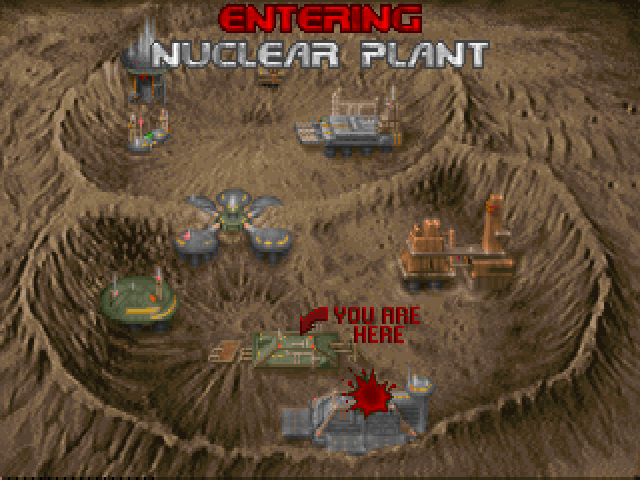
- E1M1: Hangar
- A nice start that deftly introduces the new possibilities of the Doom engine over earlier, flatter games like Wolf3D. Probably way more iconic in its own time, but it feels less special today because things like “corners that aren't just 90 degrees” and “platforms at different heights” are such basic parts of fully-3D level design.
- E1M2: Nuclear Plant
- If the last level's a demo, this one's the real thing. Romero ramps up the verticality and detail and adds branching paths and a pretty big optional area, the mainframe maze, a web of dark and boxy corridors with very tense lighting (Romero seems to use this area to show off different effects, like solid beams, flickering, pulsating).
- E1M3: Toxin Refinery
- Secrets within secrets within secrets… the first part of the level is very cool, with lots of windows you can use to see lower rooms and attack enemies below… though on pistol start you're better off not, for most of them, because there are Shotgunners down there who'll shred you.
- E1M4: Command Control
- Where Romero's levels are visually but not always physically interconnected (you can see other places but can't go there directly, like in E1M7), Hall's and Petersen's are often the opposite (non-linear layout made of more self-contained rooms) and sometimes a bit confusing for it. This is also one of the tougher pistol starts in E1 because shotgun ammo's so scarce at the start, leaving you killing Zombiemen and Imps with nothing but a pistol.
- E1M5: Phobos Lab
- Some memorable moments here—picking off soldiers in the central courtyard before you gain access to it, struggling through a brutal ambush in the west, and dealing with the dark room of Fuzzies and Imps at the end. That last room's pretty well-designed to take advantage of the darkness, with a bunch of pillars to block your view, and a layout that's just asymmetric enough to be confusing.
- E1M6: Central Processing
- Big monster-closet ambushes; Romero loves to put a small army of enemies behind walls and then bring those walls down when you push a switch or collect a key nearby. The first one, east of the start, is more interesting because it's got a more deliberate arena with obstacles that break up the space. The last one, at the end of the level, is just a brutal gotcha. A surprisingly easy pistol start for how deep in the episode it is, though. Lotta fun little areas with sinister structures, like the almost monumental computer slabs, the concrete precipice holding the blue key over a deep, dark lake of ooze, or the orb of technology overhanging the claustrophobic final trap…
- E1M7: Computer Station
- Maybe the highlight of the episode just by how indirectly interconnected it is—the nukage rooms with all the balconies and walkways at different heights, the jutting level-exit wing you can see through windows swarming with enemies, the windowed corridors over the nukage river—despite how abstract DOOM's geometry often is, all this connection makes it feel more real. A gargantuan gauntlet from pistol start.
- E1M8: Phobos Anomaly
- Frankly, all the boss levels are easy to pistol start, relative to the rest of them. This one's the most interesting, because it's not just a symmetrical arena, it has a buildup. The arena itself is one of the most open spaces you've been in so far, and also claustrophobic. Then there's the twin thrones/sarcophagi of the bruiser brothers; the way once you kill them the walls descend to reveal the light of day in a vast and slightly sad architectural sigh of relief; and how despite your victory the end of the episode tosses you into darkness to get chewed up and spat out both physically and rhetorically.
- E1M9: Military Base
- There's one or two interesting things here (the ominous layout descending from the bright upper courtyard to the dark lower bunker areas, the summoning circle, the implicit story in the cage full of Imps) but mostly it's just a series of combat rushes where 5–10 enemies ambush you as you go down a set of stairs and drive you back until you kill them all.
One thing that strikes me about this episode is how a lotta the levels share specific design features in an almost remixed way. Some examples:
- a courtyard full of nukage with a Ψ-shaped walkway with walls or fences for cover (M3, M5, M6)
- a finale with three corridors joined in a Ψ shape where the central one has a staircase leading to the level exit (M3, M4)
- a prow of the building with lots of windows that extends into an open area you can access elsewhere (M2, M7)
- a dark and claustrophobic maze of orthogonal paths (M2, M4)
- large, nukage-filled rooms with walkways and separate balconies/windows/perches, connected by passages outside the room (M5, M7)
These aren't just straight re-use. Instead, these parts are remixed and recontextualised. The nukage courtyard in M3 is cramped, gives enemies visual cover, and has you start at the shaft. The same feature in M5 has you enter from the right and fight enemies on more even footing, taking cover behind narrow walls. The last one, in M6, has you start on the middle prong, with a good view of the whole courtyard, but divides the left and right from each other with walls. I dunno in what order Romero designed the maps (he was the sole designer on all of them except M4 and M8) but in some cases it really feels like the later ones build on concepts from before, making them bigger and more complex, almost like he was inventing and refining his understanding of 3D game design as he went along (particularly the common features in M2/M7 and M5/M7).
From another point of view: All the episodes have their motifs, and this almost modular repetition and expansion works very well in the rational “techbase” setting of E1. That said, the settings in DOOM are rarely literal, since the engine wasn't powerful enough for realistic places. Instead, they go for a sense of place through emotional rather than rational “truth”. The mainframe maze in M2 and the airduct maze in M4 have no physical reason for being mazes, but they get across the feeling of creeping through a hostile, unfamiliar space with twists and turns all over the place.
Episode 2: The Shores of Hell #
Most levels drafted by Tom Hall, then finished by Sandy Petersen; a few (M5, M6, and the small boss and secret levels M8 and M9) by Petersen alone.
- E2M1: Deimos Anomaly
- Kinda the odd one out among the M1s in that it has keycards and significant branching paths. While it doesn't really establish the episode's tone as well as E1M1 and E3M1, I do like the inverted cross setpiece that hurts you as you walk through it—really sets expectations that you're not in Kansas any more and there are things here that'll hurt you in ways you can't immediately understand. I kinda wish they'd kept on that theme, but the only other moments like that in the rest of the episode are the whole deal with E2M4 and the fake exit in E2M6.
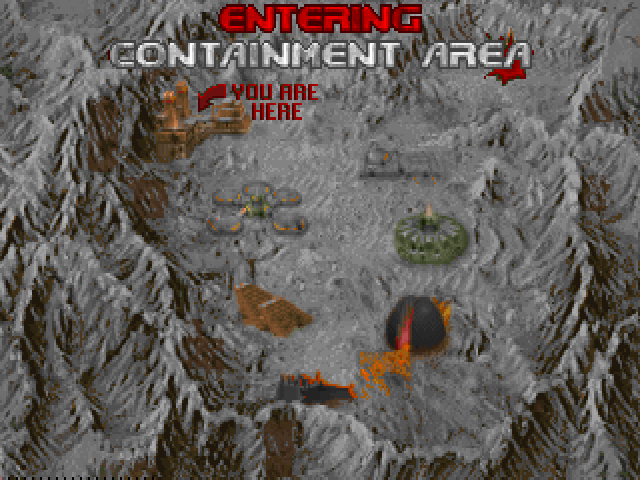
- E2M2: Containment Area
- The warehouse has a fun layout, lots of enemies waiting in ambush, but the fact that you just fight similar-sized groups of Imps and Pinkies through almost the whole map makes it feel a bit flat. I do like the anomalous vein of marble castle cutting through the techbase, though, separating the disorderly but mundane warehouse from the malevolent purposelessness of the grungy corridors and crushing machines on the other side. Another small touch is the two similar level entrances in the warehouse—most DOOM maps are these alienated fortresses, one way in one way out and otherwise disconnected from anywhere else, but a few like this and E3M3 imply a broader world with their multiple entrances (even though you always start at the same one in-game).
- E2M3: Refinery
- Not sure what to make of this—it's oddly bright and colourful, but also really flat, and feels kinda like a poor imitation of E1. Anyway, pistol start's a little rough, especially by the time you get to the dark room with pillars, but nothing too hard.
- E2M4: Deimos Lab
- A strange level with very strong narrative and thematic touches. It's not just the actively malicious architecture—the shadowy secret that closes up as you approach, the waiting crusher that lures you in with the yellow key—or the flood of uncontained nukage in the first area, or the strikingly manic wall-of-faces texture near the end. The main thing that gets me is the middle of the level, wandering through these near-featureless dark and blue/bright and red corridors to find the keys that let you go on, until you finally break through from the ruined techbase (with a touch of hell) to a refined gothic castle (with a touch of tech). More than any of the previous levels in the episode, this feels like some kinda psychic break where the nature of reality shifts and the undeniable truth is revealed.
- E2M5: Command Center
- It's got a decent start, but so much of the rest of it's just corridors. I don't have a good sense of what's where and there isn't really enough what to be worth caring about where it is anyway. Pistol start is pretty rough, so I tend to go for the plasma gun secret if only to get a bunch of shotgun ammo from the enemies guarding it, and I never wake the Hell Barons in the nukage courtyard.
- E2M6: Halls of the Damned
- Despite the devious setup at the start, the rest of it's kind of a slog thanks to the big ambushes and lots of Pinkies. I found that in pistol start you've also gotta do all the branching paths in a strict order, too, or else you'll probably run out of health and ammo. It does have a pretty incredible trick with an elaborate fake exit ambush, though.
- E2M7: Spawning Vats
- Sits at a strange midpoint between open and closed, where it feels like you could choose your own route through a non-linear map, but actually you have to get all three keys in the order blue–yellow–red following a specific path and there's just this other totally optional part of the map with a bunch of enemies and most of the secrets. Pistol start on this map is extremely lop-sided in that not only do you go from very weak at the start (like all pistol start runs) to strong by the end, all the toughest fights are before the first key and after that it's smooth sailing.
- E2M8: Tower of Babel
- Not much to say, it's a DOOM boss monster in a DOOM boss arena so basically it's a bad fight in a bad map. The Cyberdemon might be my most hated enemy in this game (and DOOM II) because of how flatly deadly it is and how much people use it. There's none of that back-and-forth play you get with a group of weaker enemies, or having to switch up your tactics because you took a hit, you either live perfectly or die and that's that. And all you do is circle-strafe!
- E2M9: Fortress of Mystery
- Funny–stupid. Infighting is essential. The dead Cacos in the Hell Baron room are a nice clue! Another case of Petersen maybe being a better encounter designer than level designer, as this level is a single neat encounter in some very basic architecture.
There's less of a clear architectural theme and design throughline here than in E1. That's probably because of how muddled the development was (over half the maps here were designed by Tom Hall, but finished by Sandy Petersen after Hall was fired). This episode does properly introduce teleporters to the game, but barely uses them after M1, and E3 has more levels where the teleporters are mandatory.
Obviously texture-wise there's a mix of techbase and hell, but this veers between alarming and just incoherent depending on how well it's used. M2 is real good for this—you're walking through this well-lit warehouse and them BAM—a cavernous portal of green marble into a darker demonic castle. It's even better for the fact that it's just sitting there in the wall and you can walk straight past to explore the rest of the warehouse before returning to find that, no, you have to go inside. M6 likewise uses different textures and layout as an infernal intrusion on the more orderly techbase. It's maps like M5 or M3 or even M1 that don't quite work for me and just feel like some rooms were arbitrarily given techbase textures and others hell textures.
I guess one notable design change in the episodes started by Hall/finished by Petersen is the switch from monster closets to more organic or complex ways of hiding and releasing monsters. You'll enter rooms with few or no visible enemies, then as you go deeper you'll get ambushed from some nook or cranny, or find more enemies behind partition walls. E2M4 even has a release mechanism where two pits of enemies slowly rise to floor-level as you push switches in the room. Monster closets still exist here, but as one of several different techniques.
Side note, I do like how the hell textures are more orderly here. Sure, inferno's intruding on the Deimos base, but it rarely goes full guts-and-gore like in E3, which makes the few cases of “hellgrowth” in this episode stand out even more.
Episode 3: Inferno #
Mostly by Sandy Petersen; some levels (M3, M6, M7) drafted by Tom Hall and finished by Petersen.
- E3M1: Hell Keep
- A solid first level despite what the haters may say. Rising out of a flesh pit onto a writhing biogeological plateau in the shadow of blood-red mountains is a strong statement, as is the tricky situation at the start with the Cacos and Imps (infighting comes in handy).
- E3M2: Slough of Despair
- For all that it's got a gimmicky shape, I think there's a good contrast between the more straightforward “finger” areas and the pillar-strewn canyon “palm”. In the fingers you only need to worry about forward and back and Petersen throws swarms of enemies at you, while the canyon's this messy landscape where you could be attacked—or attack the enemy—from any direction, and there are threats and rewards lurking around every corner. It's also the only map in the game that's a natural landscape, pure hostile geology. As for pistol start, it takes a bit of finesse—this level's scarce on ammo even played normally.
- E3M3: Pandemonium
- Maybe the best level in the episode, with warren-like asymmetry and connectivity, weird use of textures, and a chiaroscuro that makes it fun and tense to creep through. As close to a Piranesian vision of hell as they get in DOOM, pillars of glowing guts and consoles of steel and concrete altars in a dungeon of oak and iron. That ascent into the shotgun room, seeing the floating monolith silhouetted against a blood-red sky… chefkiss. Pistol start is little rough at first because you've gotta immediately sprint out of the entryway or the nearby Pinky will trap you, and then you've gotta manage a messy combat without going too far to the left or right. In fact, on pistol start I wouldn't go down the left or right sides of the map at all.
- E3M4: House of Pain
- God how does this keep going. It's got some fun touches, like the big torture room you can only look into from outside (an eerie subversion of the game's, or at least Romero's, “if you can see there, you can go there” philosophy). However, it also goes on way longer than it feels it should in a mostly-linear slog.
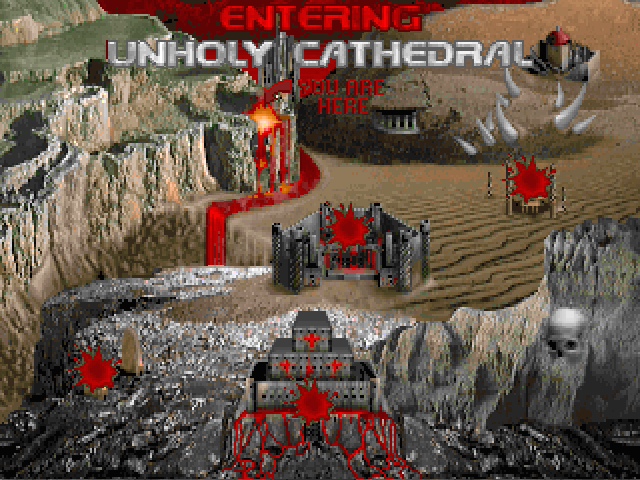
- E3M5: Unholy Cathedral
- At first I kinda hated this thanks to how 3/4 of the big teleporters in the central arena just put you back in the middle of that room (until you learn which one takes you back out), but while doing UV pistol start I found out something cool: If you aggro a lotta enemies in the outer rooms, then teleport into the middle, they'll slowly trickle in after you by opening the doors at the big teleporters and walking through. This creates a big, chaotic, infight-friendly brawl. I dunno how reproducible it is, but it makes for a way more interesting run.
- E3M6: Mt. Erebus
- Weird level, mechanically. It's not always clear to me why certain monster closets open up. Structurally, it's one of the most interesting in the game, a stab at fully-open level design with self-contained combat challenges. Petersen would distill this further in some of his much-maligned DOOM II maps like MAP12: Factory and MAP13: Downtown, but here the shapes and layout are more interesting. It's like a chaotic whalefall of temples from Earth into Hell, now attended by demons and their spawn.
- E3M7: Limbo
- Surprisingly easy after the big firefight at the start and the big ambush in the west, though pistol start involves a hell of a lot more Pinky-punching than I'm normally comfortable with. The blood maze is a neat idea, but unlike most mazes in the game there are barely any enemies, and so many Radiation Suits there's no tension at all. Really the level's main problem is how same-y the pillar teleporters look given that you need to visit most of them in a specific order and they're across hazardous terrain.
- E3M8: Dis
- See E2M8 except this one's a little more interesting on pistol start because you've gotta get infighting going and use that distraction to gather enough ammo to actually kill the boss.
- E3M9: Warrens
- A classic mindfuck. The whole time I was waiting for the other penny to drop and damn did it ever.
The most experimental episode by far. E1 cleanly and continuously builds on itself and E2's unfocused and sometimes forgettable, but here almost every level's an attempt at something new. Maybe gimmicky, definitely distinctive, and with a few bangers. If E2 is two designers clashing, E3 is them working together (though of course that's not really true given one of them was pushed out of the company and the other brought in to quickly clean up their work for publication). It doesn't always work out, but there's a stronger sense of narrative in each level. Plus, the secret level's easily the best in the game and that's not even just because the others are mid.
Episode 4: Thy Flesh Consumed #
By American McGee, John Romero, Shawn Green, Tim Willits, and John Anderson… the first three worked on DOOM II, but weirdly Petersen didn't come back for this despite being such a huge presence on both games.
(There's sadly no intermission map for this episode.)
- E4M1: Hell Beneath
- Okay, I see what people mean when they call this one of the hardest levels in the game. Very dense, very cruel, a claustrophobic rush where enemies and scarcity are equal threats. There are tough levels to pistol start, but you can almost always run past enemies to find resources elsewhere—here there is no refuge, just hell itself trying to swallow you whole.
- E4M2: Perfect Hatred
- By Romero, basically his DOOM II map MAP29: The Living End in miniature. No rest, a gauntlet of unremitting ferocity, a triathlon in a meat grinder whose finale is a high arena you can see from the start (with a hidden Cyberdemon). I know this all sounds like a good challenge, but the start is absurdly dependent on RNG (whether you get good infighting, how many Cacos approach you at a single time, how often the Cacos block each other's shots). I'm guessing you need to move lightning fast with perfect knowledge of the level, like a rabid version of the route I took on E2M4: Phobos Lab before I found the secret shotgun at the start. (This is the only map from the first four episodes that I haven't done UV with pistol start and deathless, since I made a save just before the Cyberdemon at the end and had to reload a few times.)
- E4M3: Sever the Wicked
- Okay, while this level is very brown and the layout is very consistent in a bad way, it does put you in an interesting situation at the start and force you to deal with it. The first minute or so is chaos—dozens of enemies with eyes on you. Once you get inside the fort, you can afford to be way more methodical, and the game starts throwing ammo, health, and armour your way to the point that it's almost too easy.
- E4M4: Unruly Evil
- Surprisingly simple and not particularly unruly. The first room has some promise—three Fuzzies in a tight space overlooked by balconies of Imps—but the two courtyard areas are easy if you get the easily-available Invincibility.
- E4M5: They Will Repent
- The other, better Bloodfalls (DOOM II had questionable level design sometimes). It's got these fun castle walkways over rivers and cascades of blood; branching and dense. Feels like it could easily be in E3, and one of the better maps there.
- E4M6: Against Thee Wickedly
- A decent challenge with fun level design until it puts a Cyberdemon in a matchbox right at the end and makes you kill them to open the exit. It's not hard by that point, just really boring (lots of rocket sniping from across the big central room and retreating back into cover). Still, all the twisty passages, the cute castle turrets, the four-way teleporter setpiece—it feels proto-Quake, very interesting.
- E4M7: And Hell Followed
- Weird hell-fort. It's not pure chaos on the level of E4M3, but it's got better texturing and traps and stays solid throughout. I especially like the altar room with the Cacos through the windows, with some weird geometry where the teleporter room offshoot is bigger on the inside than it appears from the outside. Pistol start's pretty easy because you get a shotgun straight away and you can generally pick up stronger and stronger weapons the whole way through—chaingun, rocket launcher, even a BFG.
- E4M8: Unto the Cruel
- It's a neat concept for a DOOM episode finale—what if the boss level had an full-scale buildup and made you work for your pile of guns and ammo and health and armour—but the final boss is a joke. A Spider Mastermind, but this time it's surrounded by even more potential infighters and you have excellent cover for the whole fight.
- E4M9: Fear
- Pistol start here is really intense but kinda stop-and-start. It's like E4M1's ambushes but with several times the space and also barrels everywhere. The layout's not much to speak of, though. It's a mishmash of techbase and hell castle without the style of e.g. E2M2, and it's symmetrical down the middle.
Inconsistency is the name of the game. Some of these levels are really nothing special by the standards of E3; others will kill you over and over again. Some have inventive styles and designs; others are bland and defined by same-y symmetry. I guess that's what happens when your episode's made by twice as many people as normal and has no single dominant designer, no overarching voice or vision. One of the few throughlines is using the Cyberdemon as a mid-boss or almost as a combat puzzle (one appears in M2, M6, M7), which is probably taken forward from DOOM II, where the Cyberdemon and Spider Mastermind are used more liberally than the first game.
Even the difficulty curve's disordered. I'm not saying anything new here when I point out the first two and half maps are the hardest by far and then things drop off (maybe aside from parts of M6). However, I don't think you could just re-order the levels from easiest to hardest, if for no other reason than the first map, Hell Beneath, feels so tuned to starting you with a pistol and full health that it really has to go first.
In the end… #
Technologically impressive, fun to play, and so generative it's hard to tell whether DOOM itself or the whole creative community it spawned has had a greater cultural impact on videogames. It's inspiring to see how something so good comes out of such restriction. Kinda thing that leaves me thinking, Could I make my own game this way? Not to say I could do the same thing Carmack and co. did in the early 90s, but I mean with modern hardware and SDL3 and 3D libraries… a DOOM-style game feels well within my grasp. As a long-term project.
That, to me, is one of the great things about playing older games in the present day: the DIY inspiration. The underlying hardware gets so much more powerful than when these games were made, and proprietary software gets reverse-engineered or open-sourced. Histories get written and technical docs get released. Engines written by highly-skilled and even obsessive programmers in bytecode or assembly or C start to look like something one dedicated person could do in a language with well-tested libraries and memory safety. Demonic hyper-optimisation is no longer necessary. I think this is part of the reason why e.g. The Legend of Zelda: Link's Awakening is such a relatively common inspiration—it's so easy to identify the basics of how the game works and build them anew. The real challenge is using that inspiration to make something good.
Will anything come of this feeling? Well, I already have a bunch of notes and I've been reading through docs on how various old-school FPS engines work while also playing a bunch of them to see first-hand, so… we'll see. I think the biggest problem is creating a proper 3D engine that goes further than DOOM (Doom engine), Blood (Build engine), and Outlaws (Jedi engine), but doesn't get as complex as the engine for id's later game Quake.
At any rate, I highly value any creative work that makes me want to create.
And what's next? #
I've already played through DOOM II on Ultra-Violence, but only deathless pistol-started through to MAP09: The Pit before hitting trouble and having to use saves. MAP10: Refueling Base completely put me off, with its enormous enemy count and Cyberdemon gimmick fight at the end. More on that game in its own review.
I've also played Strife, Quake, Quake II, Unreal, Half-Life, Outlaws, Blood, Eye Juice (a DOOM total conversion), DUSK, and about half of Heretic and Perfect Dark, and for many of those I've got big reviews at least half-written already (you can also find short reviews on Naploggd). Also on the list to play are Hexen, Pathways into Darkness, Duke Nukem 3D, Deus Ex, GoldenEye, maybe the first two TimeSplitters games, the Marathon series, the System Shock series, Cruelty Squad, Shooty Shooty Robot Invasion, Selaco, Cultic, and Captain Wayne, though a lotta those cost real money so who knows when I'll get around to playing them all.
Playing all these similar games, old-school shooters, and learning about their tech and development, has given me a lot to think about. I've gotta put the words somewhere, so here they are and will be.